
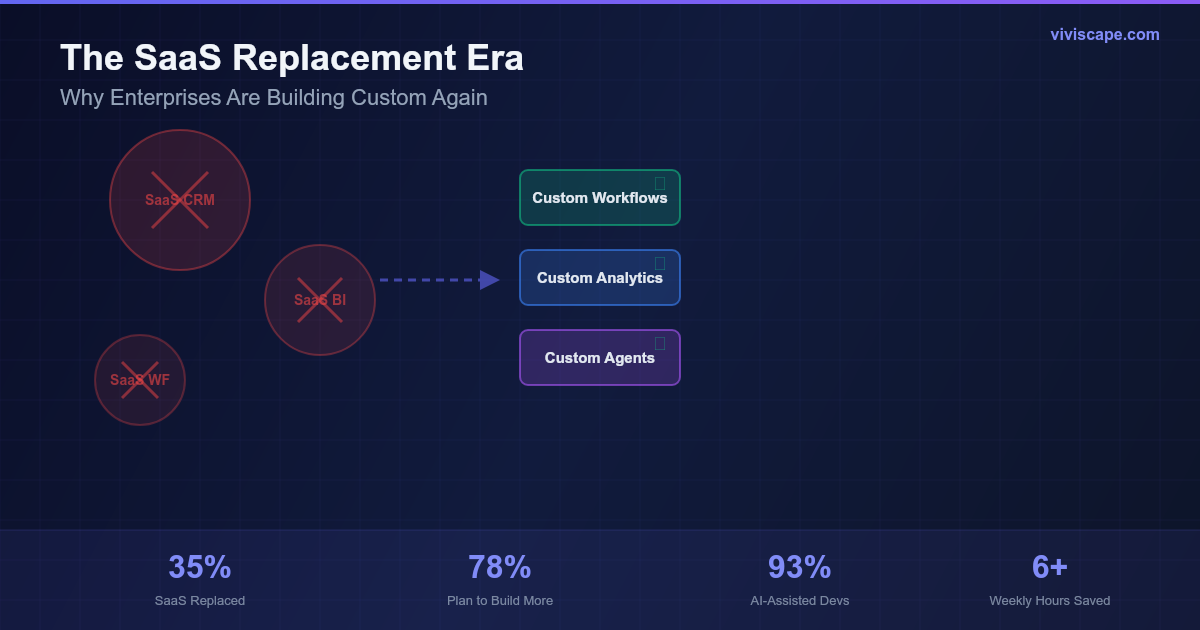
Thirty-five percent of enterprise teams have already replaced at least one SaaS tool with custom-built software. Seventy-eight percent plan to build more in 2026. Workflow automations, admin tools, BI dashboards, CRMs, and project management platforms — categories that SaaS was supposed to own permanently — are being rebuilt in-house.
This is not a regression to the pre-cloud era. It is the next phase. The SaaS model solved the problem of accessibility: any team could deploy enterprise software without infrastructure. But it created a new problem — rigidity. And in 2026, the cost of rigidity has become higher than the cost of building.
Welcome to the SaaS replacement era.
What Changed
Two forces converged to flip the build vs buy equation:
AI Compressed Build Timelines
Ninety-three percent of enterprise developers now use large language models for coding work. Fifty-one percent have built production software using AI assistance. The timeline to build a custom internal tool has compressed from months to weeks — and in some cases, days.
This changes the fundamental economics of build vs buy. When building a custom CRM integration took six months of engineering time, buying a SaaS product and accepting its limitations was the rational choice. When AI-assisted development can produce a custom workflow tool in a week — one that fits your exact data model, integrates with your exact systems, and serves your exact process — the buy calculation stops making sense for an increasing number of use cases.
Seventy-two percent of developers use AI to write discrete code snippets integrated into larger projects. Thirty-one percent prompt their way to complete applications. The tooling is not replacing developers. It is amplifying them — making custom development accessible at a cost point that competes with SaaS subscriptions.
SaaS Reached the Rigidity Wall
The SaaS model works when your needs match the product's assumptions. It breaks when they do not. And enterprise needs are increasingly diverging from what standardized SaaS products assume.
The categories being replaced tell the story. Workflow automations — 35 percent replacement rate — fail when the workflow is unique to the organization. Internal admin tools — 33 percent — fail when the data model does not match the SaaS schema. BI tools — 29 percent — fail when the metrics that matter to your business are not the metrics the dashboard was designed to show. CRMs — 25 percent — fail when the sales process requires custom fields, custom stages, and custom integrations that the platform's configuration cannot accommodate.
These are not niche complaints. They are structural limitations of the one-size-fits-many model. And the gap between what SaaS provides and what the organization actually needs is exactly where the AI vendor reckoning is playing out: enterprises are no longer willing to reshape their processes to match their software. They want software that matches their processes.
The Shadow IT Signal
The most telling data point in the 2026 build vs buy landscape is not about technology decisions. It is about organizational behavior.
Sixty percent of enterprise builders created tools outside IT oversight in the past year. Twenty-five percent do so frequently. And the builders are not junior developers sneaking around the rules — 64 percent are senior managers and above.
When your most senior people are bypassing official procurement to build their own tools, that is not a governance failure. It is a market signal. It means the approved tools are not meeting their needs, and the barrier to building something better has dropped below the frustration threshold.
The top reasons for shadow building confirm this: speed (31 percent), unmet needs (25 percent), and slow IT processes (18 percent). Shadow IT is the enterprise's immune response to tool inadequacy. And in 2026, AI has made that immune response dramatically more effective — senior managers can now build functional tools without waiting for engineering resources or IT approval.
Are your teams building shadow tools because your SaaS stack does not fit?
That is a signal, not a problem. The question is whether you channel that energy into governed custom development or let it fragment across ungoverned shadow IT.
The shadow agents governance crisis documented what happens when AI tools proliferate without oversight. Shadow IT follows the same pattern: the tools work, but the governance, security, and maintenance implications compound silently.
When to Build, When to Buy
The SaaS replacement era does not mean enterprises should build everything. It means the boundary between build and buy has shifted — and most organizations have not updated their decision framework to reflect that shift.
Buy: Systems of Record
Enterprise resource planning, core financial systems, compliance-heavy platforms — these are domains where you are paying for decades of edge cases, regulatory adaptations, audit trails, and support infrastructure. The cost of rebuilding these systems exceeds the cost of their rigidity. Buy them.
Build: Systems of Differentiation
Custom workflows, AI-powered decision support, domain-specific agent systems, process intelligence — these are the capabilities where competitive advantage lives. When the tool IS the process, and the process IS the differentiation, buying a generic version means buying a generic advantage. Build these.
Build the Glue Layer
The highest-value custom development in 2026 is not replacing SaaS products entirely. It is building the integration and intelligence layer that connects them. Sixty percent of AI development time is consumed by connecting systems, managing APIs, and ensuring data flow — work that off-the-shelf integrations handle poorly because every enterprise's system landscape is different.
The orchestration trap applies directly: the value is not in the individual tools but in how they coordinate. Custom orchestration — connecting your CRM to your ERP to your AI models to your operational workflows — is where most enterprises extract the most value from custom development.
The Productivity Reality
The productivity case for custom-built tools is clear: 49 percent of custom tools save six or more hours per week. Thirty-three percent save one to five hours. These are not theoretical efficiency gains. They are measured time savings from tools built to fit the exact workflow they serve.
Custom AI solutions demonstrate a 70 percent higher success rate in production compared to generic alternatives. The reason is straightforward: a tool built for your data, your process, and your users does not require the adoption gap that generic tools create. The last mile problem — the gap between technical deployment and organizational adoption — shrinks dramatically when the tool was designed for the specific context it operates in.
But the productivity case comes with caveats that honest advocates acknowledge:
Maintenance is real. Twenty-six percent of organizations cite maintenance burden as a barrier to custom development. A SaaS vendor maintains the product for you. A custom build requires ongoing engineering investment. The build decision must include the total cost of ownership, not just the initial development cost.
Security requires discipline. Forty-one percent cite security concerns. Custom tools built outside governance frameworks — the shadow IT pattern — create the same compliance and security risks as shadow agents. Custom development needs the same governance stack that AI agents need.
Integration is the hard part. Thirty-nine percent cite integration challenges. Building a tool is increasingly easy. Integrating it into the enterprise system landscape — authentication, data flows, audit trails, existing workflows — remains difficult. This is precisely why the glue layer matters more than the application layer.
The New Decision Framework
For enterprise leaders evaluating build vs buy in 2026, the framework should account for how AI has changed the equation:
1. Calculate the rigidity cost. What does your organization spend — in workarounds, manual processes, and missed opportunities — accommodating the limitations of your current SaaS tools? If the rigidity cost exceeds the build cost, the decision is clear.
2. Assess the AI development capability. With 93 percent of developers using LLMs and 51 percent building production software with AI assistance, the question is not whether AI-assisted custom development is viable. It is whether your organization has the governance and deployment infrastructure to support it.
3. Evaluate maintenance honestly. A custom tool built in a week still needs to be maintained for years. Include ongoing engineering cost, security patching, and feature evolution in the total cost calculation. The build is the beginning, not the end.
4. Govern the shadow IT. If your senior managers are already building shadow tools — and statistically, they probably are — the governance decision is not whether to allow custom development. It is whether to bring it inside the governance perimeter where it can be secured, maintained, and supported.
5. Build the platform, not just the tool. The organizations getting the most value from custom development are not building one-off tools. They are building internal development platforms that make custom tool creation repeatable, governed, and maintainable. The tool is a deliverable. The platform is a capability.
The Bottom Line
The SaaS replacement era is not anti-SaaS. It is post-SaaS — a recognition that standardized software solves standardized problems, and enterprise competitive advantage increasingly lives in the non-standard.
Thirty-five percent of enterprises have already made this shift. Seventy-eight percent plan to accelerate it. AI has compressed build timelines, lowered development costs, and made custom software economically viable for categories that SaaS dominated for a decade.
The question for every enterprise leader is not build or buy. It is: where does our competitive advantage require custom capability, and are we building it — or are we buying someone else's version of it?
The SaaS era gave enterprises access to software. The replacement era gives them ownership of it.
ViviScape builds custom enterprise software — from AI-powered workflow tools to full platform development. If your SaaS stack has hit the rigidity wall, let's build what actually fits.
Ready to replace rigid SaaS with software that fits your business?
ViviScape builds custom enterprise software — from AI-powered workflow tools to full platform development.
Book a Free Consultation