
Eighty-two percent of executives say they are confident their existing policies protect against unauthorized AI agent actions.
Eighty-eight percent of organizations reported confirmed or suspected AI agent security incidents in the past year.
Read those numbers again. The gap between executive confidence and operational reality is not a rounding error. It is a governance crisis — and it is happening inside organizations that believe they have the situation under control.
Welcome to the age of shadow agents.
What Shadow Agents Are (and Why You Cannot See Them)
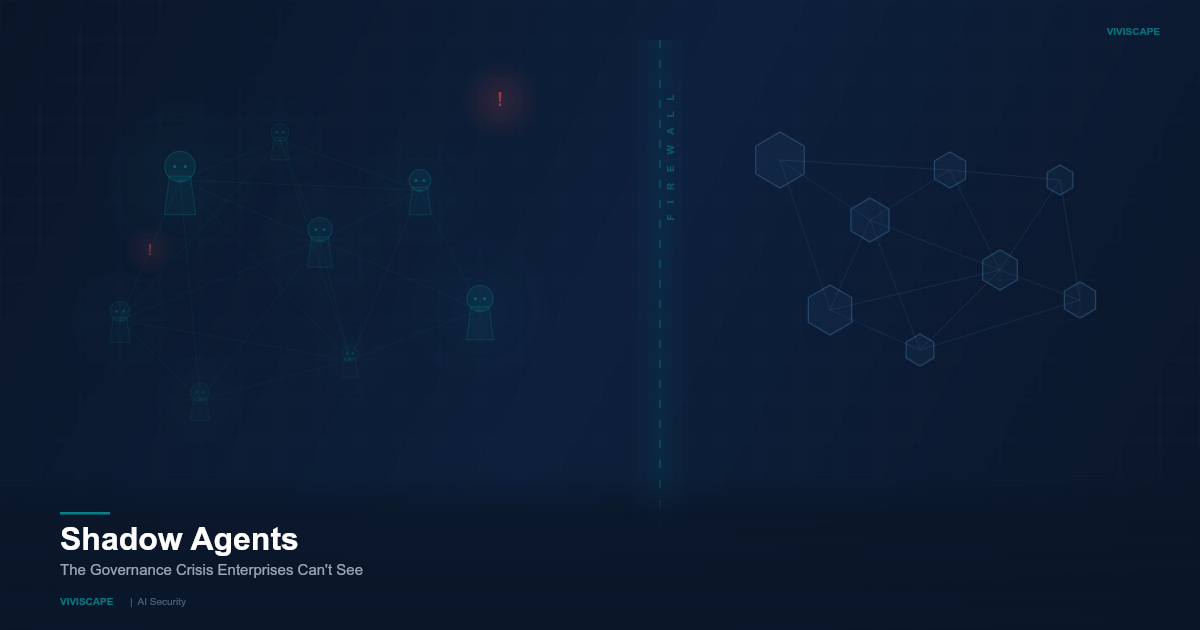
Shadow IT is a familiar concept: employees adopting tools outside official channels. Shadow agents are its more dangerous evolution. These are AI agents deployed across an organization without full security review, operating without logging, authenticating with shared credentials, and in some cases, spawning other agents autonomously.
According to Gravitee's 2026 State of AI Agent Security report, only 14.4% of organizations have full security and IT approval for all AI agents going live. That means roughly 86% of agents are launching with incomplete or no governance sign-off.
More than half of all deployed agents operate without security oversight or logging. They are functionally invisible to the teams responsible for protecting the organization.
This is not a future risk. It is the current state of enterprise AI.
The Numbers Behind the Crisis
The scale of ungoverned agent proliferation is staggering:
Growth is outpacing governance. Zenity's 2026 Threat Landscape Report documented 280% tenant growth in AI agents over 12 months at a Fortune 20 technology company. A Fortune 50 financial services firm saw 180% growth in agent, app, and automation volume. At a Fortune 50 pharmaceutical company, over 2,000 agent and app instances were shared organization-wide — many without any security review.
The builders are not security professionals. Eighty-two percent of AI system developers at the pharmaceutical company lacked a professional security development background. When the people building agents do not have security training, governance gaps are not exceptions — they are the default.
Healthcare is the most exposed. While 88% of organizations overall reported security incidents, the rate in healthcare reaches 92.7%. In an industry governed by HIPAA, patient data regulations, and life-critical systems, nearly every organization has experienced an agent-related security event.
Agents are creating agents. Perhaps the most concerning finding: 25.5% of deployed agents can autonomously create and task other agents. Ungoverned proliferation is not just a human problem — the agents themselves are compounding it.
The Identity Crisis at the Heart of the Problem
Most organizations have not solved a fundamental question: what is an AI agent, from a security perspective?
Only 21.9% of organizations treat AI agents as independent, identity-bearing entities. The rest treat them as extensions of human users — inheriting human credentials, operating under human permissions, and invisible as distinct actors in audit trails.
This creates three cascading failures:
Shared credentials destroy accountability. When an agent authenticates using a human user's API key, there is no way to distinguish agent actions from human actions in logs. If an agent makes an unauthorized data access, the audit trail points to a person who may not even know the agent exists. Gravitee found that 45.6% of organizations rely on shared API keys for agent-to-agent authentication.
Hardcoded authorization is brittle and unauditable. Another 27.2% use custom hardcoded authorization logic — patterns that cannot be centrally managed, rotated, or monitored. When a security incident occurs, there is no systematic way to revoke agent access across the organization.
Permission inheritance amplifies risk. When agents inherit human-level permissions, they often have far more access than they need for their specific task. A sales automation agent operating under a sales director's credentials has access to everything the director can see — customer data, financial records, strategic plans — regardless of whether the agent's function requires it.
The False Confidence Problem
The most dangerous aspect of the shadow agent crisis is that leadership does not know it exists.
When 82% of executives express confidence in their governance posture while 88% of their organizations are experiencing incidents, the disconnect is not ignorance — it is a structural visibility gap. Traditional security monitoring was designed for human actors and known applications. AI agents operate in patterns that existing tools were never built to detect.
An agent that queries a database at 3 AM, passes results to another agent, which then calls an external API, which triggers a workflow in a third system — this chain of actions may be entirely legitimate or entirely unauthorized. Without agent-specific identity, logging, and policy enforcement, there is no way to tell the difference.
The organizations that achieved dramatic security improvements — like the Fortune 200 consulting firm that saw a 90% reduction in security violations after deploying preventative agent security — did so only after acknowledging that their existing controls were fundamentally inadequate for agentic workloads.
What Governed Agent Deployment Actually Requires
Solving the shadow agent problem requires treating it as an architectural challenge, not a policy update. Five capabilities are non-negotiable:
1. Agent Identity as a First-Class Security Primitive
Every agent needs its own identity — distinct from its creator, its operator, and other agents. This means unique credentials, scoped permissions, and an audit trail that tracks the agent as an independent actor. Without this, governance is impossible because you cannot govern what you cannot identify.
2. Pre-Deployment Approval Gates
No agent should reach production without explicit security review. This does not mean slowing innovation — it means building approval into the deployment pipeline the same way code review is built into software delivery. The goal is making governed deployment the path of least resistance, not an obstacle to route around.
3. Continuous Runtime Monitoring
Static policy checks at deployment time are necessary but insufficient. Agents operate dynamically — their behavior may change based on inputs, context, or instructions they receive at runtime. Continuous monitoring must track what agents actually do, not just what they were approved to do.
4. Scoped, Rotatable Authentication
Shared API keys and hardcoded credentials must be eliminated. Each agent needs scoped authentication tokens that grant only the permissions required for its specific function, with automatic rotation and centralized revocation capability. When an incident occurs, you need the ability to shut down a specific agent's access in minutes, not days.
5. Spawn Control
If agents can create other agents, that capability must be explicitly governed. Every spawned agent should inherit governance requirements from its parent, require the same approval gates, and be traceable in the same monitoring systems. Ungoverned agent-to-agent creation is how a manageable deployment becomes an unmanageable sprawl.
Do you know how many AI agents are running in your organization right now?
If the answer is not precise, you have a shadow agent problem.
The Cost of Waiting
Organizations that delay agent governance are not saving time. They are accumulating risk that compounds with every ungoverned deployment.
The Fortune 50 financial services firm that Zenity profiled achieved an 80% risk reduction across 150,000+ resources — but only after building the governance infrastructure they should have had from the start. Every day between initial deployment and governance implementation was a day of unmonitored exposure.
Shadow AI breaches are estimated to cost significantly more than standard security incidents because they are harder to detect, harder to scope, and harder to remediate. When you do not know an agent exists, you cannot know what it accessed, what it shared, or what downstream systems it affected.
The rise of enterprise AI agents is not slowing down. The question is whether governance will catch up before the next incident — or after.
The Bottom Line
The shadow agent crisis is not a technology problem. It is an organizational design problem. Enterprises adopted AI agents faster than they adapted their security models, and the result is a governance gap that executive confidence surveys cannot close.
The organizations that will navigate this successfully are the ones that treat agent governance not as a compliance checkbox, but as a core architectural requirement — as fundamental as network security or access control.
You cannot orchestrate what you cannot see. And right now, most enterprises cannot see what their agents are doing.
ViviScape builds AI agent architectures with governance designed in from day one — not bolted on after an incident. If your agent deployment has outpaced your security model, let's fix that.
Ready to govern your AI agents before the next incident?
ViviScape designs agent architectures with identity, monitoring, and governance built in — so you can see what your agents are doing before regulators ask.
Book a Free Consultation